Features

Everything Lunas does today.

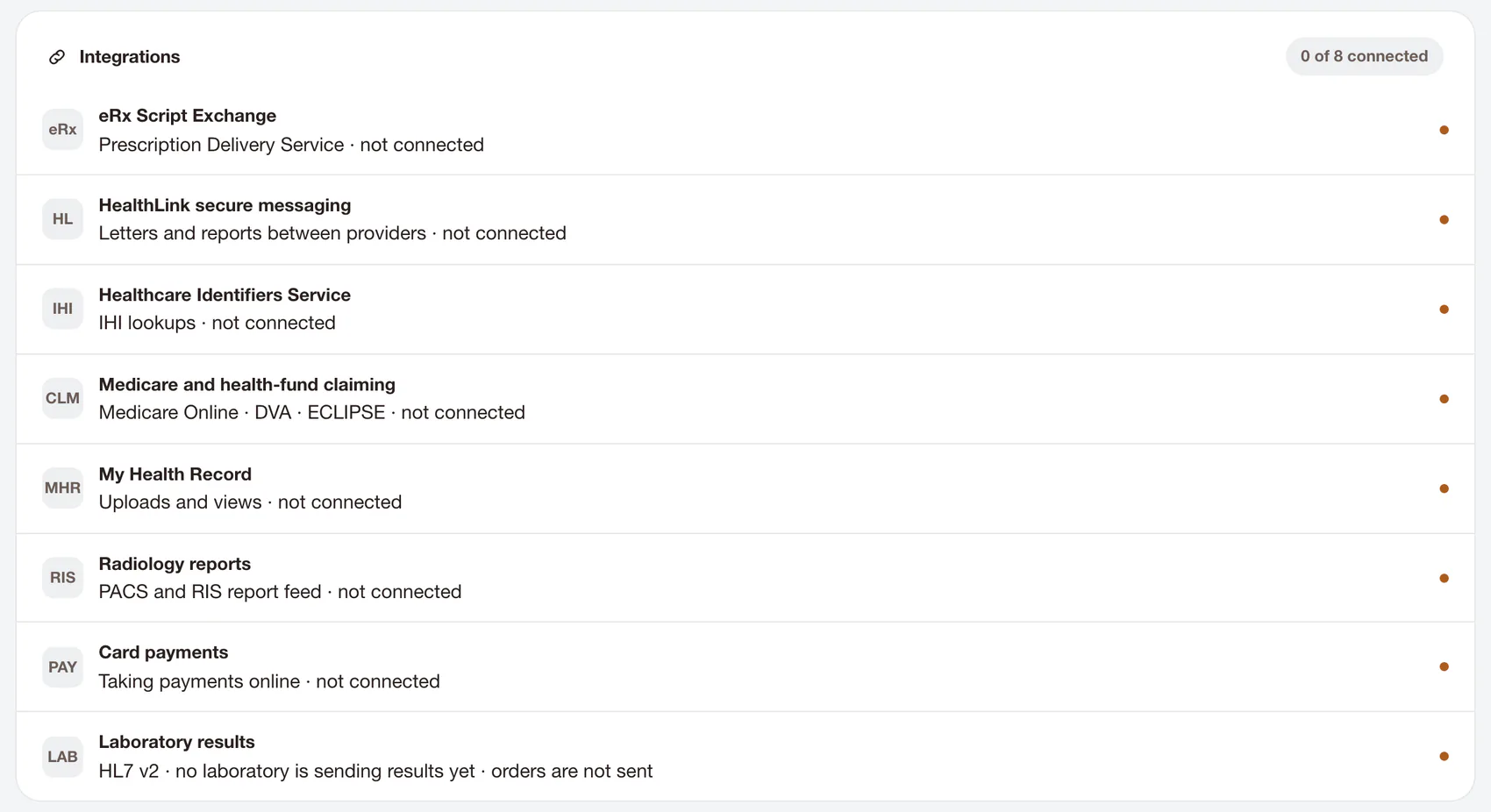
The chart, results, prescribing, notes, video visits, the patient portal, the money, the roster and the hospital — built, running, and on one record. What isn’t connected yet is listed at the end, in plain words.

The screens on this page are from the Lunas demo, with invented patients; the illustrations say so.

Clinical work

The day, the chart, the results and the prescription.

The work of a consultation, in the order it happens, with the evidence beside every claim the software makes.

Today

The morning in one screen, counted from live data.

What needs the clinician, in order: results waiting for review with the critical one first, the day’s patients, open tasks and unread messages. Every number is counted from the records underneath it. Nothing on it is a picture.
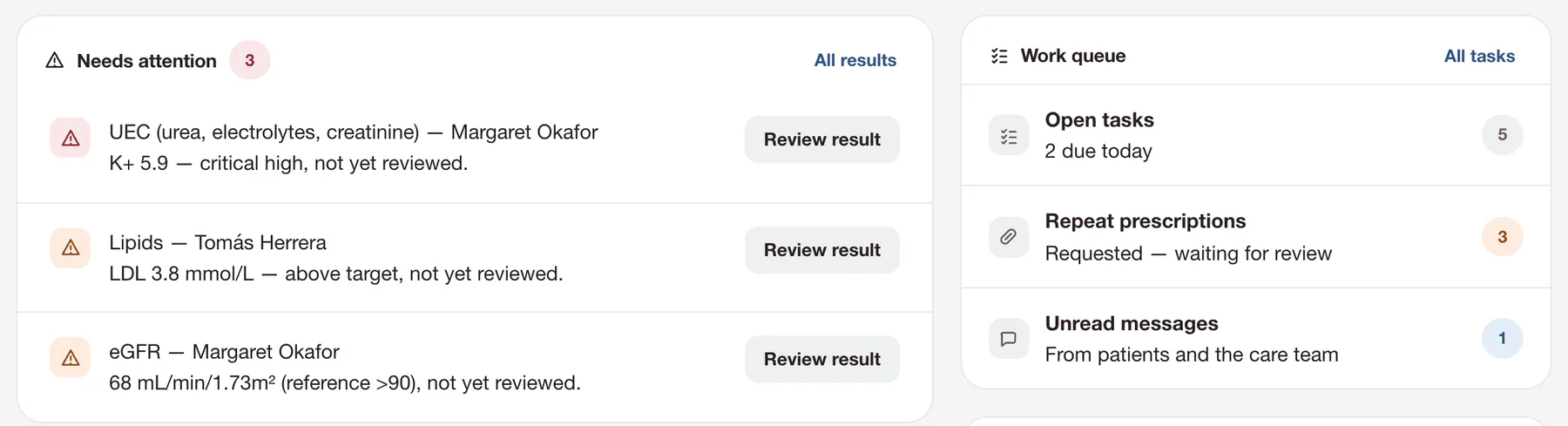
  • Results to review, the critical one first, with its value
  • The day’s patients and video visits, read from the diary
  • Tasks, repeat prescriptions and messages waiting
  • Suggested next actions, which you take or leave
The Today screen: three results need attention, the first a critical potassium of 5.9 for Margaret Okafor, beside a work queue of five open tasks, three repeat prescriptions and one unread message.
The chart

One calm page per patient.

What needs attention sits at the top, next to the data it came from. Allergies come first — red when there is one, amber when nobody has asked yet, because “no known allergies” and “never asked” are different facts.
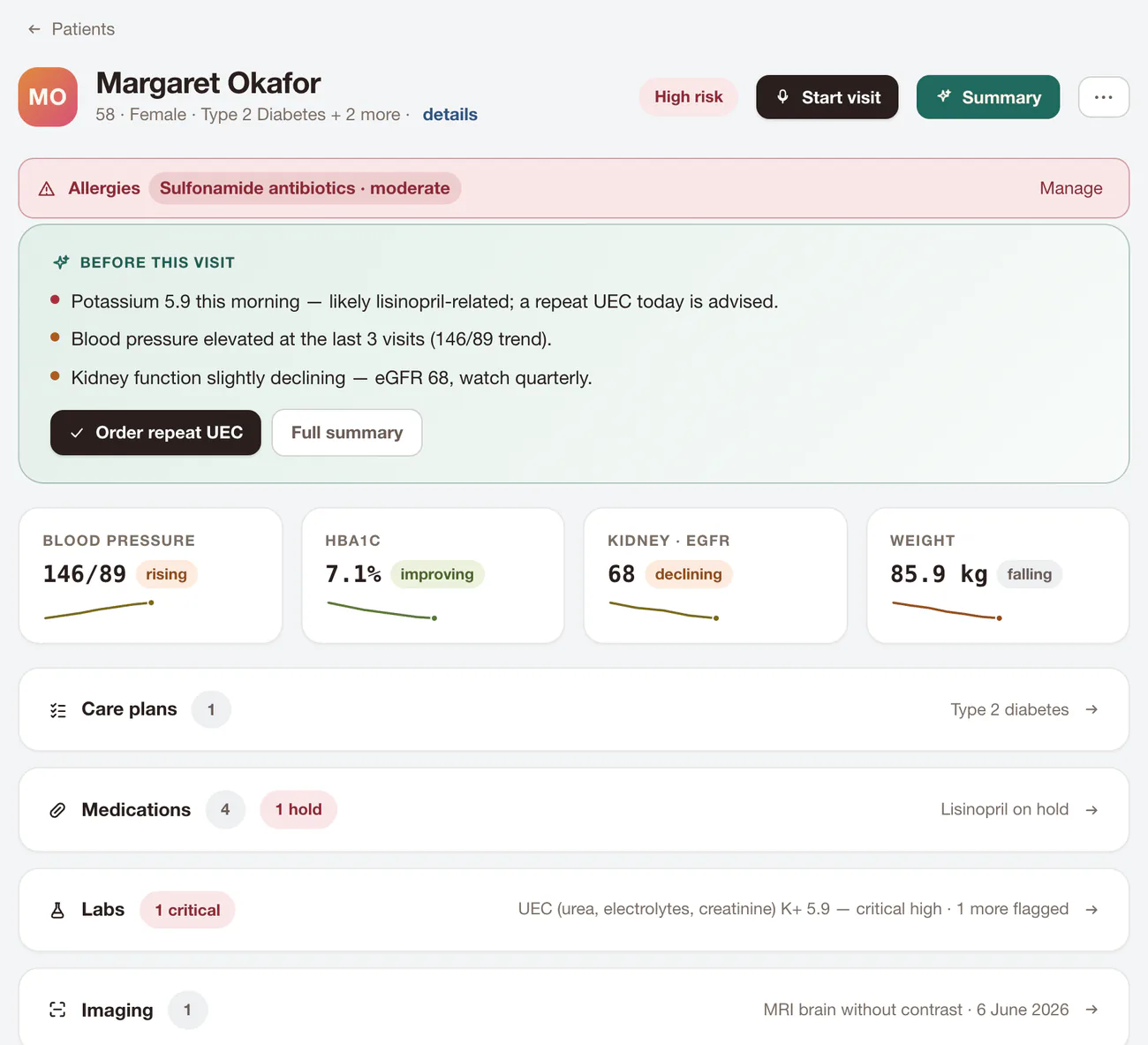
  • Allergies up front, and a medicine that could cross-react is flagged before it is prescribed or given
  • Trends worked out from the patient’s own readings
  • Medicines, results, imaging and care plans in sections that say what’s inside before you open them
  • A timeline of visits, results, messages and notes, with the care team’s discussion on each
Margaret Okafor’s chart: an allergy strip for sulfonamide antibiotics, three points to cover before the visit, blood pressure rising, HbA1c improving, kidney function declining and weight falling, then folded sections for care plans, medications, labs and imaging.
Results inbox

Results arrive by HL7. The doubtful ones wait for a person.

Laboratory results arrive as HL7 v2 messages, through the endpoint a laboratory posts to. Each is matched to its patient, read against its reference range and filed. A result that can’t be matched to exactly one patient is held for a person to match, and to say how they confirmed it.
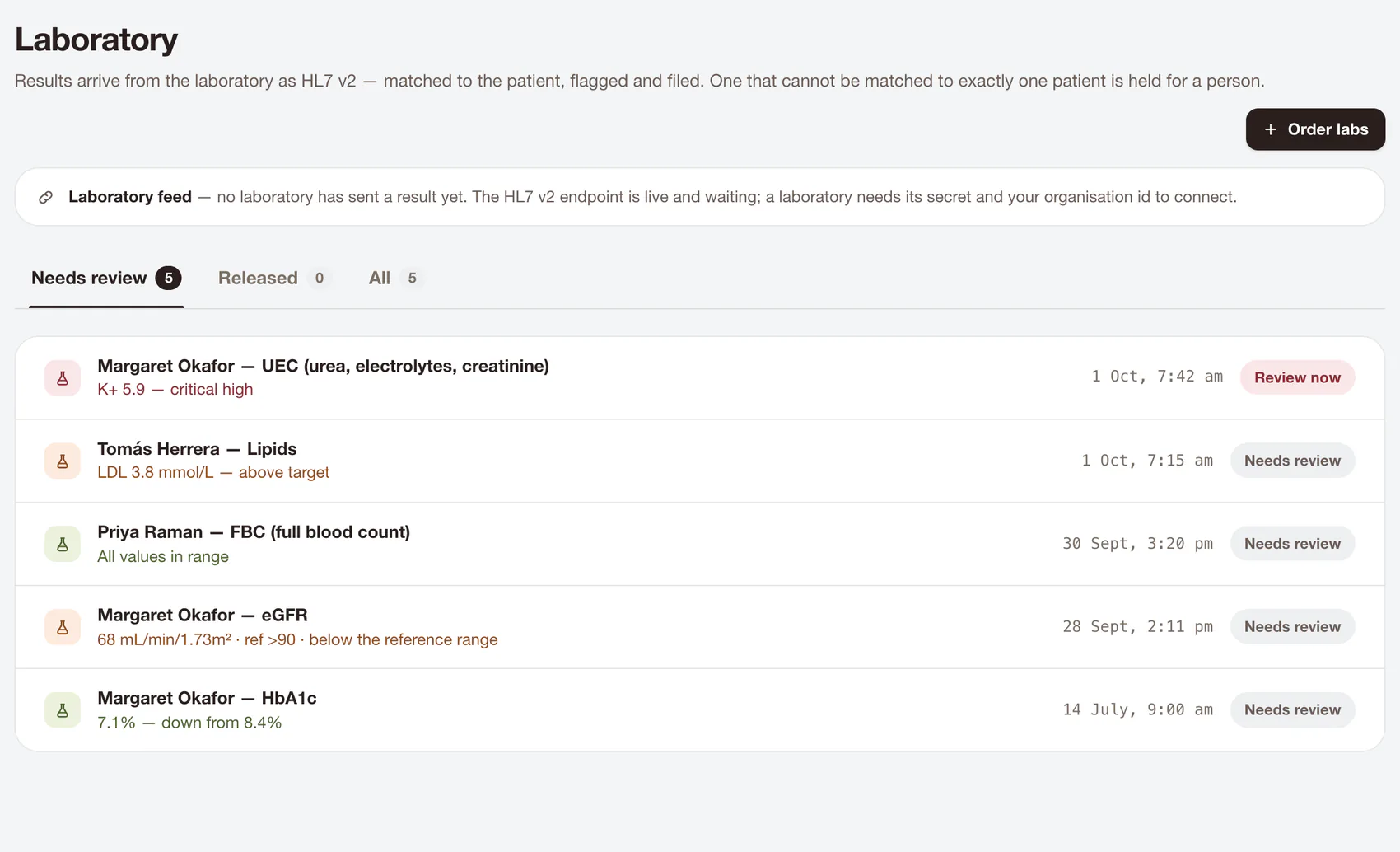
  • An HL7 v2 laboratory feed, with its activity shown on the page
  • Held when two identifiers disagree: a result on the wrong chart is worse than none
  • Values read against their reference ranges, critical results first
  • Tests can be ordered and are audited; sending orders to a laboratory is still to come
The laboratory results page, explaining that results arrive as HL7 v2 and that one that cannot be matched to exactly one patient is held for a person, above five results needing review, from a critical potassium to an HbA1c that is down from 8.4%.
Prescribing

A prescription is checked before it is recorded.

As a medicine is typed, Lunas checks it against this patient’s own record: allergies and cross-reactivity, the medicines they already take, and kidney function from their latest eGFR. It says what it checked, and what it couldn’t. To go past a stop, the prescriber records why, and the reason stays with the prescription.

  • Cross-reactivity weighed by the reaction that was recorded: after anaphylaxis it stops, after a rash it cautions
  • Interactions with the medicines already on the chart
  • With no eGFR on file it says “not checked”, never “passed”
  • It records the prescription. Sending it to a pharmacy electronically isn’t connected yet
New prescription — Margaret OkaforIllustration
Medication
Spironolactone 25 mg
Stop · major interaction

With lisinopril, on her chart: together they can raise potassium, and hers was 5.9 this morning.

Checked
Allergies — sulfonamide antibiotics, recorded
Current medicines — four on the chart
Kidney function — eGFR 68, from the laboratory
To go past this stop, record why
The reason is kept with the prescription
Recorded in the patient record · not sent to a pharmacy

An illustration of the check with the demo patient. The checks use a starter list of common medicines and well-established interactions, not a licensed drug database; a site can load its own formulary.

AI notes

It drafts the note. You check it, and sign it.

With the patient’s consent, Lunas listens to the consultation and drafts the note. Every sentence links to the lines of the conversation it came from, and nothing reaches the record until the clinician signs.

Margaret OkaforFollow-up · blood pressure and potassium Margaret agreed to transcription · 9:02

Transcript

  1. 00:00

    How have you been since we paused the lisinopril?

  2. 00:06

    Better. The dizzy spells in the afternoon have mostly stopped.

  3. 00:13

    My home readings are still about 150 over 90, though.

  4. 00:21

    Your repeat potassium is back to 4.8, so that has settled. The blood pressure is still higher than we’d like.

  5. 00:34

    Let’s leave the lisinopril off and start amlodipine, five milligrams each morning.

  6. 00:45

    We’ll recheck your blood pressure and kidney function in two weeks.

Draft note Check, edit and sign

Subjective

Afternoon dizziness has mostly settled since lisinopril was paused. Home blood pressure readings around 150/90.

Objective

Repeat potassium 4.8 mmol/L.

Assessment

Potassium settled; blood pressure remains above target.

Plan

Lisinopril stays on hold; start amlodipine 5 mg each morning. Recheck blood pressure and kidney function in two weeks.

Nothing is saved to the record until Dr Doe signs it.

An illustration with an invented patient. Point at a sentence, or its number, to see the line it came from.

Consent first

Nothing is transcribed until the clinician records that the patient agreed. Without consent, the visit simply has no transcript.

A draft, never a decision

The clinician edits it, checks it and signs it. Until then it is a private draft in the visit.

Every sentence has a source

Each sentence links to the lines it came from, so the note can be checked at a glance.

Where it runs

In Australian-hosted cloud, or on the practice’s own Lunas Edge AI box (early access). If the box is down, the scribe says so and stops; it never sends the conversation anywhere else.

The assistant

An assistant that shows its working.

Ask about a patient — a summary, their allergies, what changed since the last appointment, a result in plain language — or about the whole practice: who is on a medicine, who has had a fall this year, what is critical. It answers from your organisation’s own records and lists what it read.

  • Each answer lists the records it was built from
  • Every question is written to the audit trail
  • It doesn’t reply to patients, release results or submit claims: a person does each of those
  • Search reads the inside of letters and reports, not only their titles
Ask about Margaret’s record, or start with “find”…
Summarise Margaret’s recordWhat changed since her last appointment?Is Margaret allergic to anything?Who is on lisinopril?find ejection fraction

Sources are listed under every answer · every question is logged

Example questions the assistant answers from the organisation’s records.
Video visits

Video visits that go straight between the two of you.

The call runs peer to peer and encrypted: picture and sound travel directly between the clinician’s device and the patient’s, and nothing is recorded. The patient joins from the portal; the clinician keeps the note beside the call.

  • Peer to peer, encrypted, and never recorded
  • A relay for networks that block direct calls, which forwards what it can’t read
  • Calls reconnect after a reload or a change of network
  • Recording and transcription stay off without consent from both sides
Patient portal

The patient’s half of the same record.

Plain language, the one thing that matters today, what’s owed and the real next appointment — on the patient’s own phone, with no app to install.
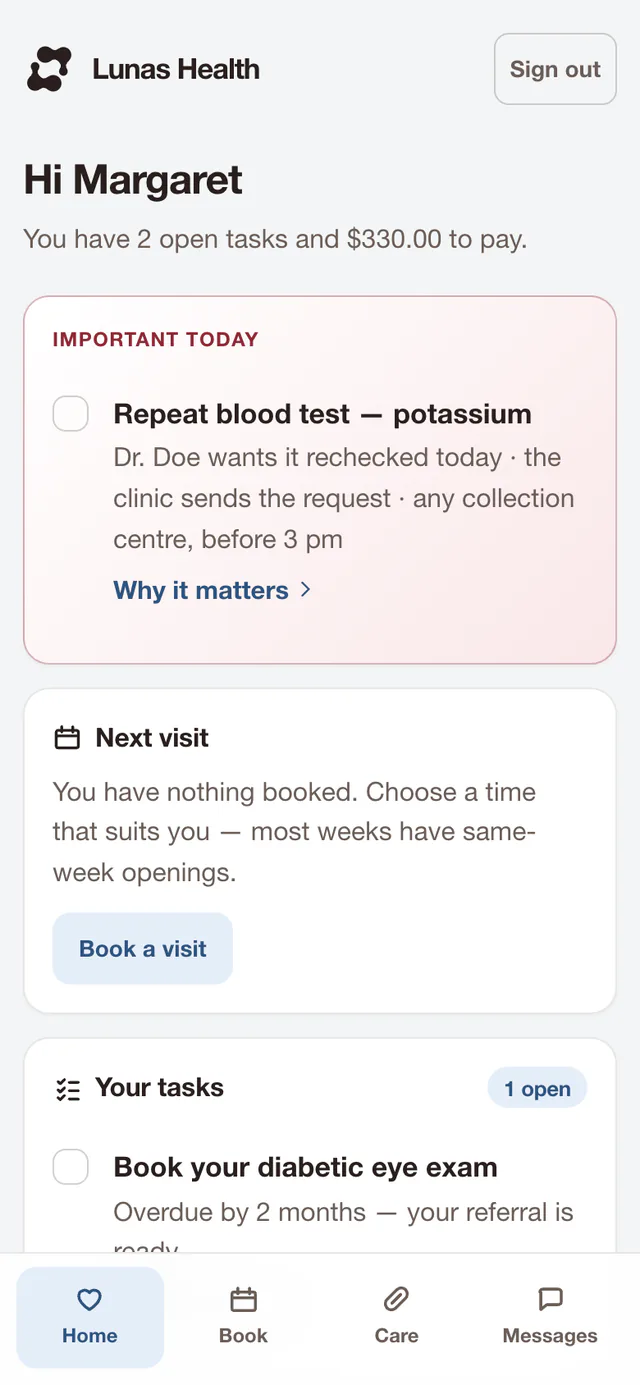
The portal home for Margaret: important today, a repeat potassium blood test; her next visit; and a task to book her diabetic eye exam.
Home
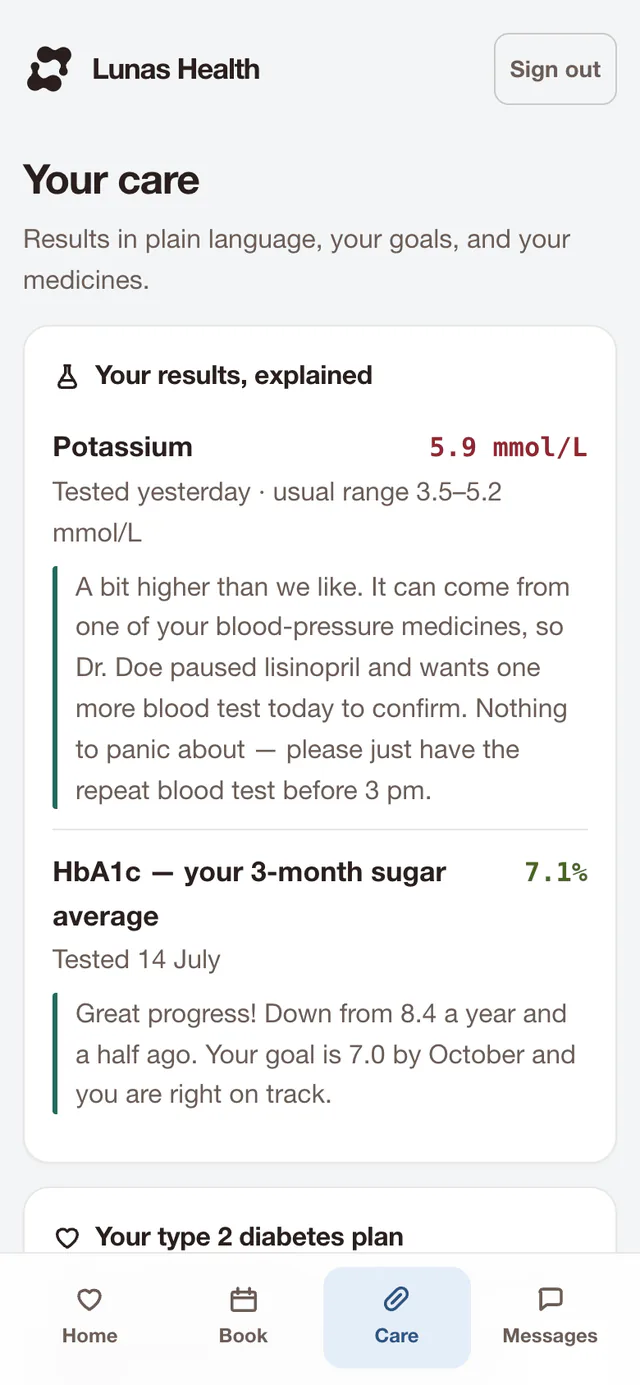
Your results, explained: potassium 5.9 mmol/L against a usual range of 3.5 to 5.2, with a plain-language explanation, and HbA1c 7.1% described as great progress.
Results, explained
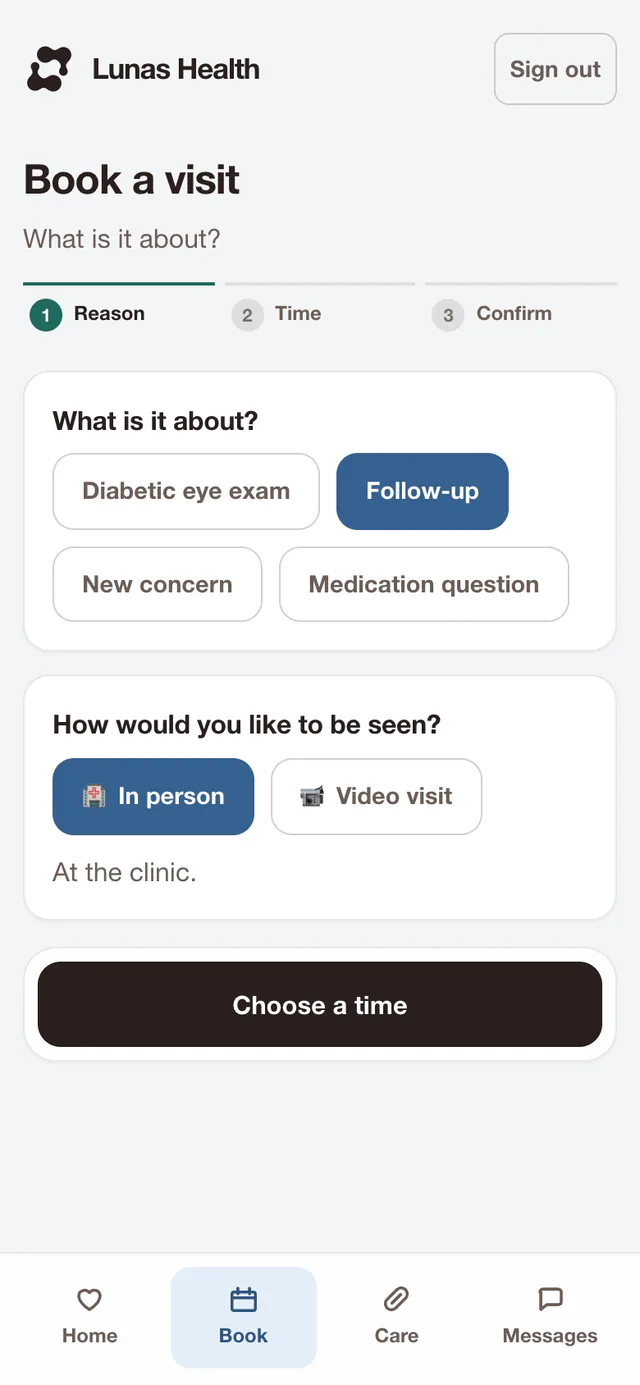
Booking a visit in three steps: what it is about, in person or by video, then a time.
Book a visit
  • Tasks that open what they ask for — a blood test, a booking, a message to the clinic
  • Booking, rescheduling and cancelling from the clinic’s real diary, so a cancelled slot is free for the next person
  • Results in plain language, with their units and the usual range
  • Messages, the account balance and joining a video visit. Paying online isn’t connected yet
Finance, stock and reports

What came in, what went out, and what care cost.

In Australian dollars, with the arithmetic shown. Where a number would mislead, Lunas leaves it out and says why.

Finance and stock

Money, stock and the cost of care per patient.

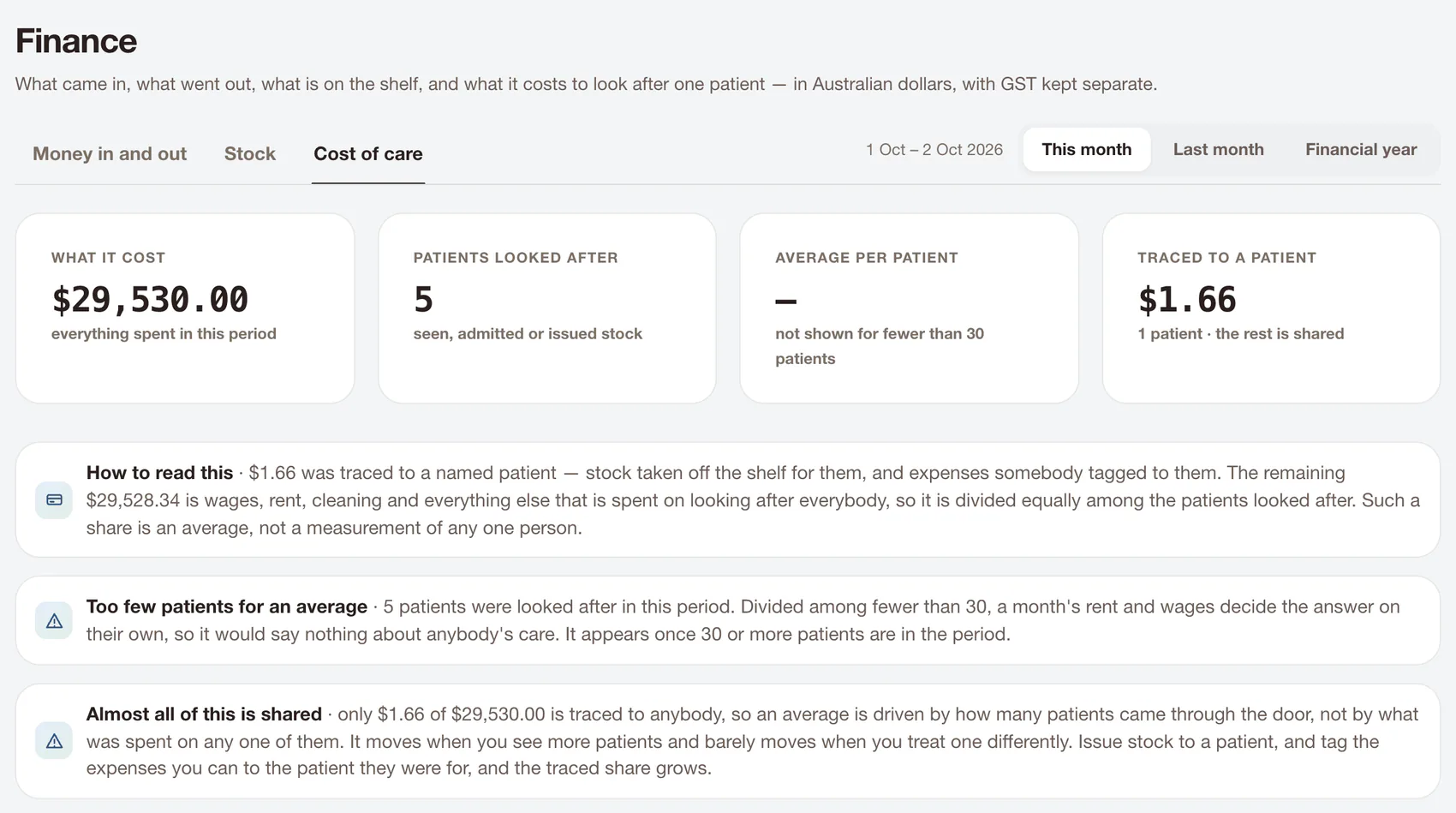
Money in and out, with GST kept separate on every line. Stock on two shelves, clinical and housekeeping: receiving stock writes its expense in the same step, and issuing it records who it was used for. The cost of care divides what was spent among the patients looked after — and says that it is an average, not a measurement.
  • GST kept separate, because most medical services are GST-free
  • Recording a payment settles the invoice and writes the income in one step
  • Stock issued against a patient traces its cost to their care
  • No average for fewer than thirty patients: it would say nothing
The cost of care tab: $29,530 spent this period across five patients, no average shown for fewer than 30 patients, $1.66 traced to a named patient, and three notes explaining how to read the figures.
Reports

Every figure says how it was worked out.

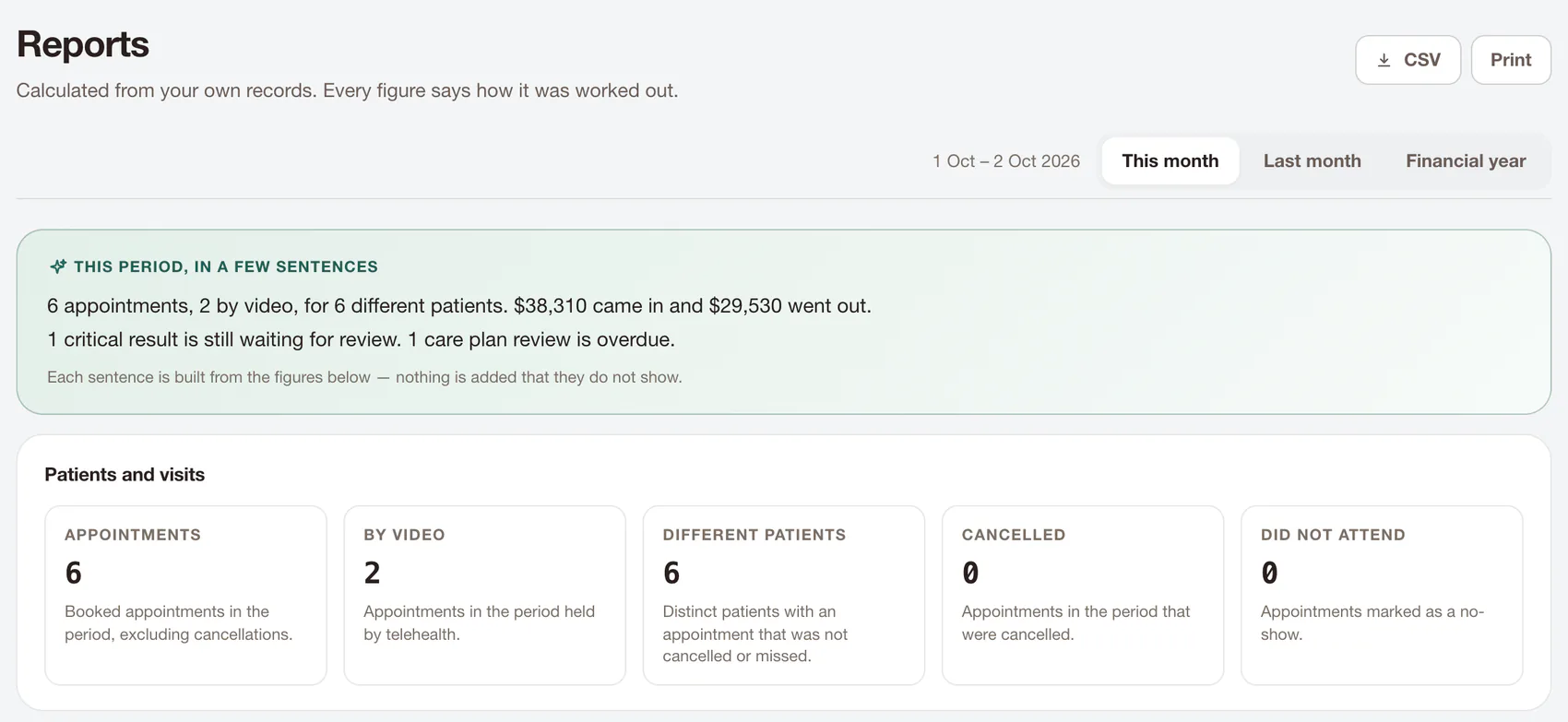
Appointments, notes, results and money for this month, last month or the financial year, calculated from your own records. A few plain sentences sum the period up, built only from the figures beneath them. Where there is no data it says “no data”, not zero.
  • The financial year starts in July, as it should
  • Export to CSV, or print
  • In a hospital, scanning rates on the drug round and how long critical results waited
The reports page: a short summary of the period in sentences, then appointments, video visits, patients, cancellations and non-attendance, each with a line on how it was counted.
Staff and rostering

A roster that refuses an unsafe assignment.

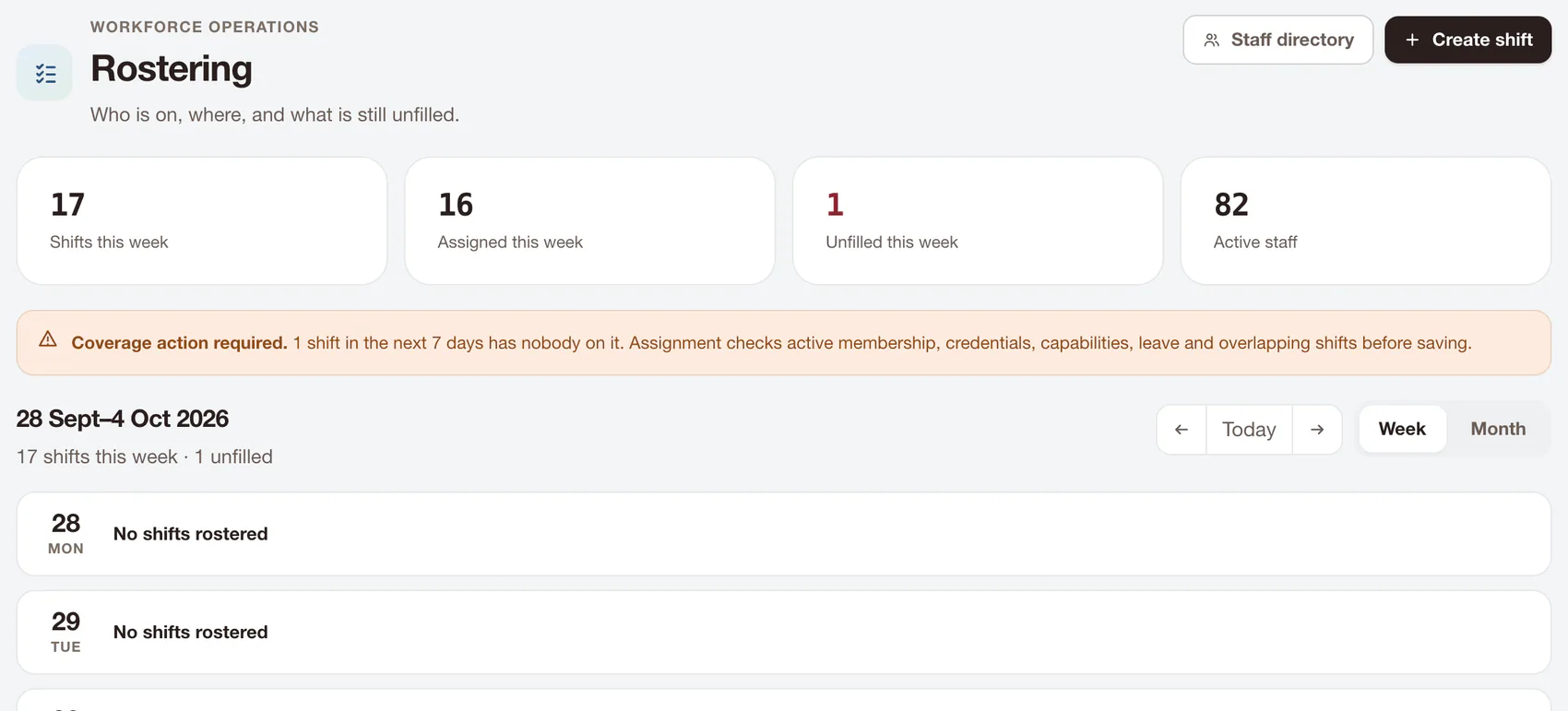
Staff records hold profession, registration, scope of practice and leave. Assigning someone to a shift checks their membership, credentials, capabilities, leave and overlapping shifts before it saves, and a gap shows on the day it falls.
  • Only the people who need a credential or registration check are flagged
  • Moving a shift is checked again against leave and overlaps
  • Week and month views, on the same calendar the clinic books from
  • Checks run against the credentials recorded in Lunas
The rostering page for a hospital week: 17 shifts, 16 assigned, one unfilled, 82 active staff, and a note that one shift in the next seven days has nobody on it.
Hospital operations

The same record, at hospital scale.

A hospital opens a command centre; a clinic never sees any of it. Each module is switched on per organisation, and writes to the same patients, staff and audit trail.
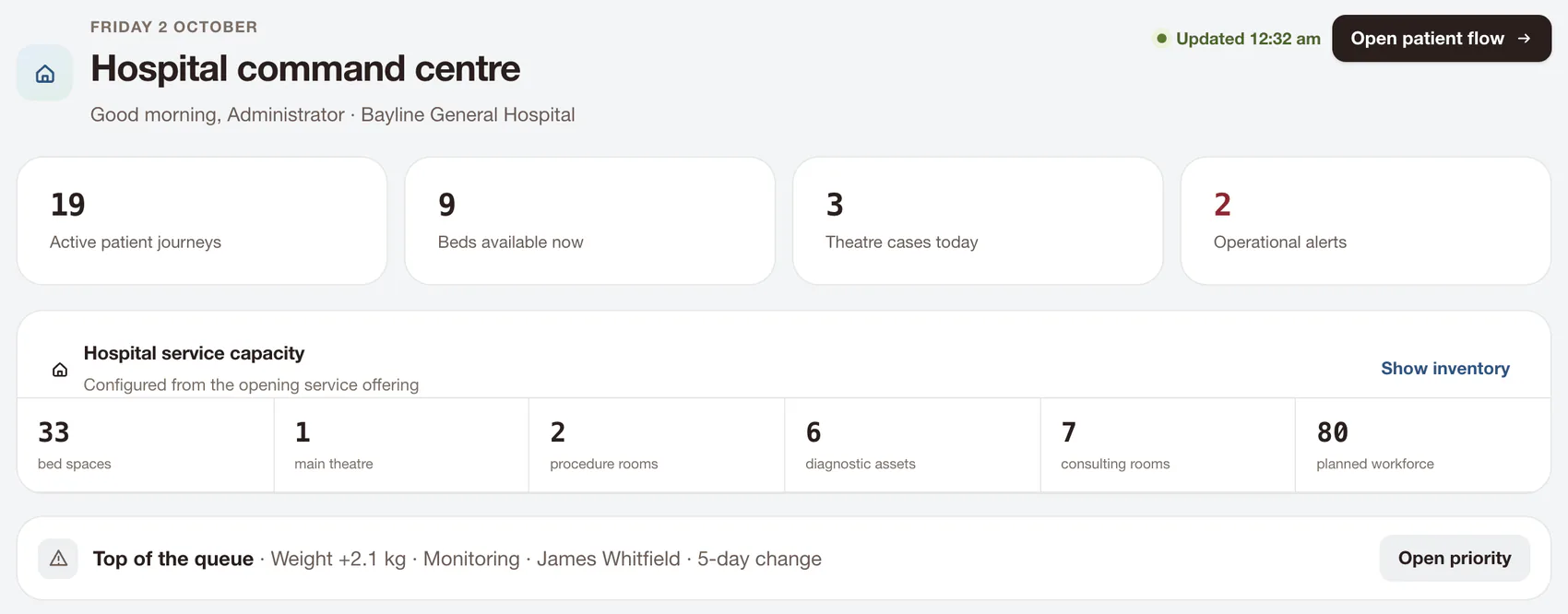
The hospital command centre: 19 active patient journeys, 9 beds available, 3 theatre cases today and 2 operational alerts, with service capacity and the top of the priority queue.
Command centre and beds. Journeys, beds, theatre and alerts on one screen, and one queue across every module, ordered by what will hurt first.
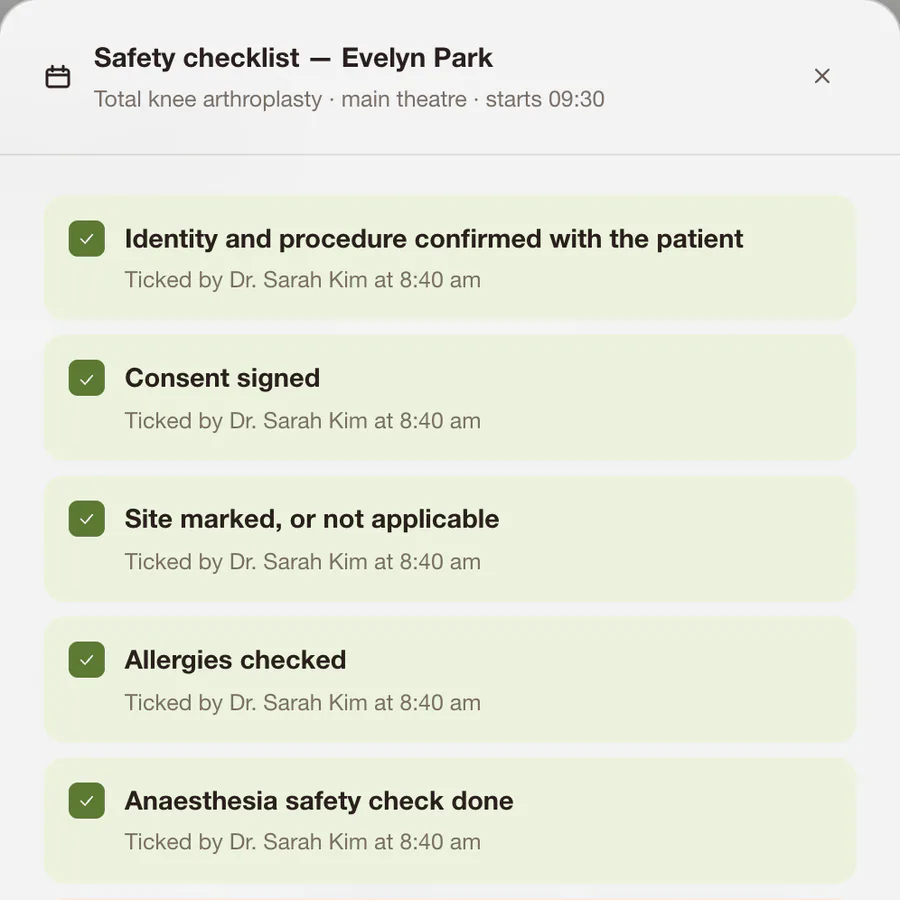
A theatre safety checklist for Evelyn Park’s knee replacement: identity, consent, site, allergies and the anaesthesia check, each ticked by Dr Sarah Kim with the time.
Theatre. Each safety check is ticked by name, with the time, and a case can’t be marked ready while one is open.
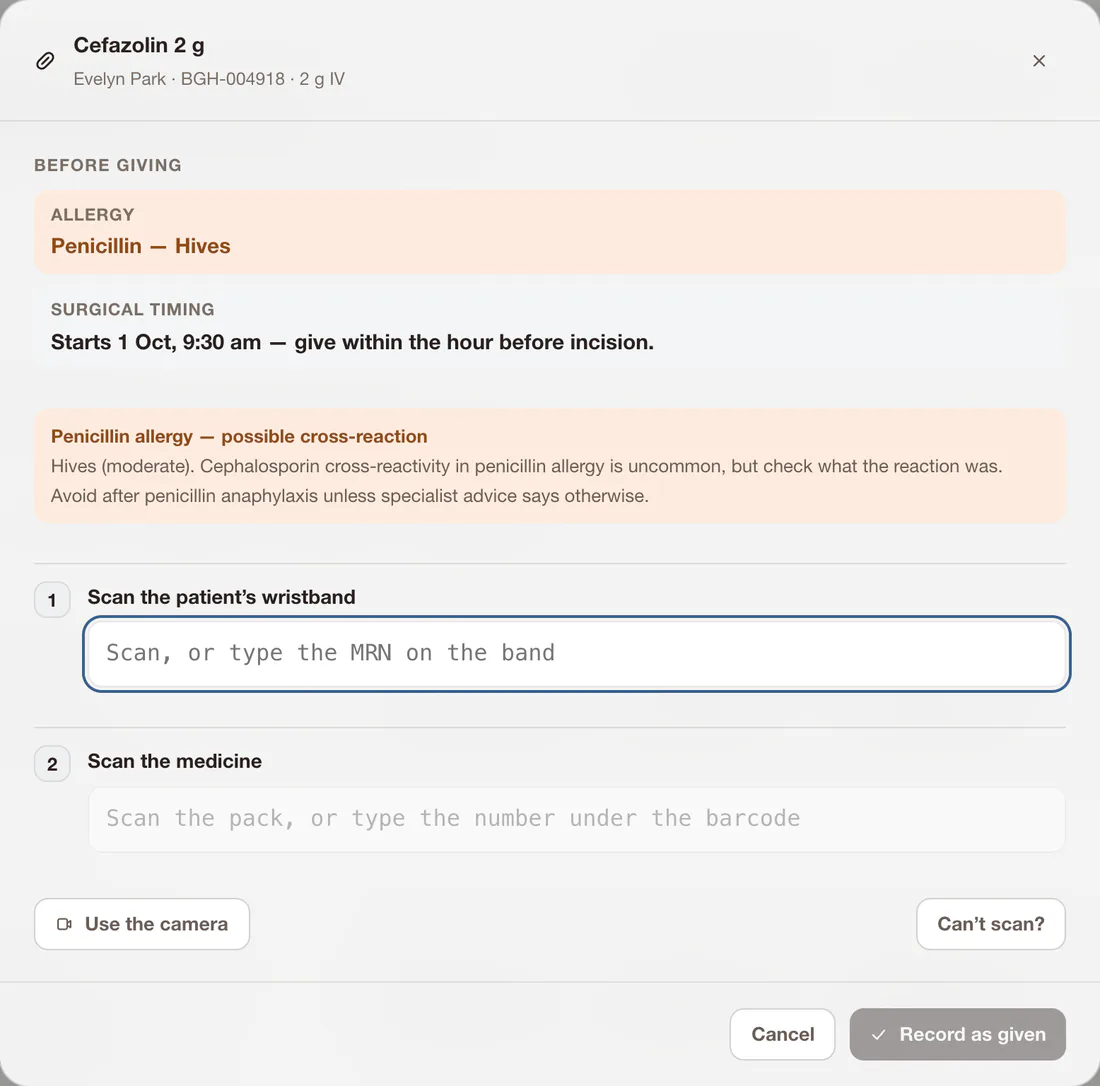
Giving cefazolin 2 g to Evelyn Park: her penicillin allergy and a possible cross-reaction shown before giving, then two steps — scan the patient’s wristband, then scan the medicine.
Medication rounds. A barcode check of the patient, then the medicine, strength and form. Rounds keep working offline and sync when the connection is back.
Admissions and flowBedsTheatreMedication roundsMonitoringRevenue cycleStatutory reporting
Explore hospital operations
Security and privacy

Built for health information in Australia.

The controls follow the record from the first sign-in to the last signed note.

Audit trails

Changes are written to an append-only trail naming who did what, and when. Questions asked of the assistant are logged too.

Australian data region

Records are hosted in an Australian cloud region, and the cloud AI it uses is hosted in Australia too.

Role-based access

A clinician, a nurse and an administrator see different actions on the same record, and the check runs on the server.

The screen locks when left

After fifteen minutes without use Lunas locks, and opens again only by signing in — never mid-call, mid-visit or offline.

No advertising, no tracking pixels, and no secondary use of health information.

See it with your own workflows.

We onboard each care team directly, with privacy, hosting and governance agreed before any real record is entered.